Showing posts with label Central America. Show all posts

Thursday, July 8, 2010

A Tale of Three Camps

Port-au-Prince Haiti--I remember listening to a young man a few years back who grew-up in one of the largest townships in South Africa and the painful emotions that easily came to the surface as he recalled his youth living in a tin shack with over a million others. There were dangers and hazards from things that we don't think much about like rain, mud, fire, water, food, and disease... As we were working in the tent camps of Port-au-Prince, this young mans words often came to my mind.

This summer during the World Cup, OneHope has been hosting Soccer clinics in many places of the world; South Africa, Columbia and Haiti just to name a few. This particular week I found myself in Haiti as part of a media team from OneHopes office, also with us was a former soccer player from the Haitian National Team. The World Cup has been a huge diversion to the everyday realities of being homeless in PAP. Everywhere we went were Brazilian or Argentinian flags. Traffic seemed to lessen during their games. Cheers could be heard everywhere when one of those teams were playing. We were there to give the kids an outlet to be kids and to bring some hope. We gave out a special Champions edition of the Book of Hope as we interacted with many of them. Check out OneHopes video on the experience as told through Ricardo Pierre-Louis.


The first thing you notice when landing in PAP are the blue tarps that are everywhere throughout the city. In any available lot you will find tents and tarps, makeshift toilets and showering facilities and lines of people. At six months out from the earthquake and you will not see new construction but rather piles of rubble. Some buildings are slowly and carefully being taken down, piles of broken cement and trash are slowly being taken out, but that is all. The scars, the cracks, the pain all very evident. And yet there is still pockets of joy and hope for a better life.

We were in three different camps. Three camps that couldn't have been run so very differently. I hate to say the horrors we saw in the first camp. Pigs running around in the garbage, open sewage, a mishmash of tents one on top of the other as they went up and down the hillside.  A long line for buckets of water. I know a few phrases in Creole and my French helps a little bit here as well so I began asking the kids how they were. At this camp almost every answer was "mal" or "faim" (bad or hungry). There had been a recent Typhoid outbreak here and most kids came begging for anything that we could give them. Our clinic got under way in the only open space available with a few drainage trenches and trucks that would periodically come through. For a few hours these kids had smiles as they ran and jumped and played a game they all love with a passion.

The next camp was on the outskirts of town in a large empty field away from everything. The tents were uniform and large all stamped with World Visions Logos. The facilities were all according to standards. The kids did not beg but were all smiles as we led them through drills and games. The day ended with a double rainbow over the camp and a GodMan showing in one of the areas designated for such activities.

The next day we spent at the Petionville Golf Course. One of the larger camps in the city. This one was run mostly by several different American Groups. We saw tents with USAID logos as well as Compassion and Samaritans Purse. The medical area was run by Sean Penn's Aid organization J/P HRO. It seemed like a large city of tents running in and out of the trees and over hills. The grass was long gone but the trees remained providing some relief from the heat. There was drainage for the water and proper facilities but this place also had all the markings of a community: a church, stores, hair salons, medical clinics, and playground. We had a very small area for our soccer clinics but we made the best of it. Argentina had just won their game as we could hear cheers throughout the area. Immediately afterwards kids came from every direction eager to show their skills with the ball. And for a few hours we had a captive audience of not just the kids but many adults watching and listening with interest.

 
The good news about the young man from South Africa who grew up in the townships is that he found help, hope and a way out. In Haiti we had balls, nets, adults that were willing to spend time with them, some water, a snack, and a book about the greatest Champion of all time... these adults will go back and continue to work with the kids. Continue praying for this nation and do whatever you can as you are able.

Photos can be found on FB or Flickr.
Next up Peru...

Sunday, May 30, 2010

Tour de Mexico

April 2010--Four flights, three areas of the country, two six-hour bus rides, another 10 hours in a car, and at least 40 interviews in six days. I am constantly amazed by the passionate and tireless people that I meet around the world. In Mexico, I met some of the most dedicated and boldest men and women around. Here are just a few of their stories:

Northern Mexico (Antiguo Morelos):
     Pastor Hugo works in a church without walls literally and figuratively. His actual church building is nothing more than what we would call a car port to hold the hot sun and rain at bay. But what amazes me is that he is willing to hold services anywhere that people want to hear the gospel. Because his church is so portable he just brings the chairs and sound system to the people whether that is a nearby ranch with many workers or an empty lot in town or his church shelter. He goes to the ranches with his barber scissors to give free hair cuts and then ministers to the children and adults using the Book of Hope. He says that the books help the children to engage in the message.

While talking with Pastor Hugo we met with a young man whose life was radically altered after a bad accident. Pastor Hugo goes regularly to disciple this young man even bringing services to him when he could not walk. Then we met a  family next to an empty lot that could not help but hear the message being preached when it was brought to their area. Their four year old was so taken by the word that he was the one leading to the family by example to receive the word. Pastor Hugo is not only a light to this community but also a father figure to the fatherless. As we drove about town he would stop the van to talk with children walking the streets, inquire about their well being, invite them to his next service an give them a Book of Hope if they had not yet received one.

Southern Mexico (Chiapas):
     Pastor Jose is a missionary in a very persecuted area of the the country. He lives in a very modest home and has a church down the street but his real work is out in the jungle and difficult places. He works with many of the indigenous peoples. Some of which have little contact with the outside world: the Lacandones, a people that dress very simply in a white dress, do not cut their hair and speak a Mayan dialect; the Tojolabales, another Mayan tribe, while many dress very traditionally, they do not live as isolated. He also works with those persecuted because of their Christian beliefs. We drove by a village of people that had all been displaced because of their faith. Another group that he has worked with are the Zapatisitas, a revolutionary group. You might say his work is dangerous but he is driven and passionate. He gave out 80,000 books last year and continues to work tirelessly among these people groups.

Central Mexico (Mexico City):
     I was privileged to join two ministries in action in the greater Mexico City area: Comodores de Amor and Talita Cumi. The first one feeds children after school in areas of need and provides additional learning opportunities for them. They feed not only the stomachs but also the souls, using the Book of Hope as a tool. I must have spoken to more that a dozen children whose lives had been changed after reading the Championes (soccer) book or Solo Nosotras, a book for girls, both version of the Book of Hope. Then I joined a group of Clowns that go regularly to the children's wards in hospitals through out the city; performing, giving gifts and words of encouragement as well as Books of Hope and prayer. It was inspiring to join these groups of dedicated people, but even more that that to see the fruit of their labors in the faces of the children.

Saturday, October 10, 2009

Pay it Forward

Bolosse, Port-au-Prince, Haiti--The morning light was peaking over the tops of the buildings and down the cramped garbage strewn streets. Morning commerce especially the food vendors were off to an early start while the others were just setting up. Children in all different colors of uniforms were walking to school. Girls in yellow and grey uniforms walking one way, boys in green walking another direction, red checked, pink, and blue...children, parents, young ones, middle ones, and teens. The young girls all wearing over sized bows in their hair, the boys were in shorts. The day just starting to heat up in temperature and activity. It was a typical morning in the capital city.
We arrived in Haiti on a Monday and left on a Wednesday. Our job was to film and photograph a milestone event for OneHope...the distribution of our 600 millionth book. We were roaming the streets of one of the more difficult areas of town gathering footage and photos to tell our story. If we had been there at night the above scene would have been very different and safety would have been a huge concern.
Wednesday morning we pull up to the chosen school. It was a peaceful place on a hillside walled off from the slums below. However, it wasn't always so peaceful. Three years back for a period of two months the school found itself under demonic attack. Everyday a different child would manifest this evil: shouting obscenities, and words of violence and destruction. The message was loud and clear: that Satan meant to steal, kill and destroy the children of this nation. However the adults came together and fasted and prayed and things began to change. The children of the school are now a shining example of transformation. A young lady by the the name of Ruth Sara received the 600 millionth book. She was a bright and articulate 13 year old who wanted to be a Doctor, Lawyer and a Diplomat. She was so appreciative to be given this honor.


Onehope was founded twenty-two years ago when Bob Hoskins, had a vision of children and youth being destroyed by violence, disease, poverty and the evils of this world. Here we were in a place that embodied all of those things in such a visible way handing out the 600 millionth book world wide, knowing full well much had been done (600,000,000 is a big number and we have so many testimonies of transformation) but much more is still to be done as it is estimated that there are 2 billion children in the world.
Something I learned in Haiti this time around is that the people here are survivors. They know how to survive with nothing. True believers know how to combat the wiles of the devil. Prayer and the word of God in Haiti is a sharp sword. There are points of bright light shining in the darkness here. We realized that if God can transform this school in Haiti, he can transform the rest of the nation and the world. OneHope's goal is to reach every single child in the world with the Word. There is an ambitious plan in place and if we continue to tell the stories like the one of Ruth Sara's school in Haiti, hope will not be lost especially for Haiti and many more will be saved.

Thursday, September 3, 2009

A Place Beyond Words


Haiti--a place that I'm not sure I can adequately describe in words. The reports you hear about poverty and corruption are true but it's not until you travel the roads that you understand to what extent. It was an adventure from the very beginning...

Four of us flew into the the coastal city of Cap Haitian on a 5-seater prop plane run by Missionary Flights International, a 4-hour flight from South Florida by way of the Bahamas for refueling. Our final destination was Pignon in the mountains. In miles it is only 39 but you do not measure distance in miles there but rather hours. It was a four-hour trip up the mountain on roads only a 4-wheel drive truck could traverse. Roads that easily produced two flat tires, a sparking battery from being knocked loose and a broken axle during our few weeks there. But miraculously there was always someone near to help with the situation.

We taught English in the morning and showed our "GodMan" film in the afternoons or evenings. It was hot and we lived without so many of the things we take for granted on a daily basis like running water, and electricity. We were staying in a facility that had hosted many Americans before us as was evident by the things they had left behind (liquid soap, hand sanitizer, screens on the windows etc..) Reality set in pretty quickly when my translator asked me to teach the kids the phrase, "I am hungry". They would beg everyday for money, food, candy, even the three sips of water I had left in my water bottle on the last day. I felt so ill-prepared with monetary things. Since we took a charter flight our cargo weight was extremely limited so we came with only the bare necessities. I honestly felt like Peter when he tells the people in Acts 3:6 "silver and gold I have none but what I do have I give you in the name of Jesus" So, we gave them the hope found in the Word.

I had the elementary students who knew very little English. Fortunately, Creole has so many French words in it that I knew most of their vocabulary words and the few I did not know they taught me the Creole equivalent. Every lesson had a devotional and object lesson component to it. And then I taught them English words and phrases from their everyday life. At the end I gave a quiz. I wanted to know more about their life. The average students had eight siblings, they ate things like rice, chicken, goat, mango, pineapple, and avocado when they could get it. Going to the well to get water is an everyday chore as well as to the river to wash. One student named Kyle said if given the opportunity he would keep going to school to learn how to fix the roads and help his family.

Showing a film was a real treat as the only form of entertainment came by way of radio. We would drive to some very remote areas, set-up our equipment and the next thing we knew there would be a crowd. The response was priceless. We had 16 showings on hillsides, valleys and fields, in clinics, churches and schools. Approximately 2700 kids and adults came out to see the life of Jesus and the power he has to forgive and roughly 400 responded.

I experienced the power of prayer in a place where spiritual warfare is a daily battle. I observed the church and the battles they face outside and within with superstition and voodoo. I still struggle to grasp the desperation that lives there, to understand the hopelessness and daily struggle for survival. And yet I know there are those making a stand. I pray for their success.

I will have another opportunity to learn more as I return in a few weeks for a milestone distribution in the Port-au-Prince area. Pray for safety and the message that we bring.


Saturday, July 11, 2009

Culture Shift


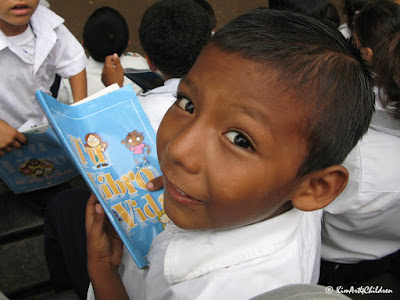
I said to this little guy, "Que es?" (What is it) and in the cutest little voice responds, "Libro de Vida" (Book of Life)

What do you call it when you are sitting in a very Latin Church service in Honduras but your mind is thousands of miles away thinking about the very African service you were in just a few weeks before? Or you are ordering food for the group in Spanish but a few words of French keep popping out of your mouth because your next French speaking destination is already in your thoughts. Then you come back to America and wonder, “What side of the road should I be driving on?”, “Where is my plug converter?” or you have a moment of panic because you can’t find your passport only to realize you no longer need these things and you’d better be on the right or else. It’s not really culture shock because all these places are familiar but the more I think about it I realize it’s more of a culture shift. Traveling from one place to another can be exciting but it also carries with it constant change, adjustments, language and protocols.

I returned from a three-month stay in South Africa the end of May, and you know, some places just make such an indelible mark on your life that take a while to readjust. I can’t complain since I chose this life, but there are days that make one wonder, where I am I today? I recently spent 10-days in Honduras with a large team and ministry was great but the whole time I could not shake Africa from my very being. Which leads me to wonder what is it that has captured me so? It’s true; nine of the last 18-months have been spent in Southern African countries. Is it the relationships? The beauty in the landscape and wildlife? The freedom and ease in bringing the gospel? I don’t know. But what I do know is that I am thankful for these opportunities and while it isn’t always easy especially in the transition times between culture shifts it is a road that I’ve been called to travel. I’m also thankful that I have supporters like you that travel with me in your prayers, giving and words of encouragement…keep them coming.


This image from a primary school in CapeTown South Africa gets me everytime. The school only went up to 3rd grade but as the principal told us the young ones knew first-hand about violence and rape and drugs already. This is why I continue...to break the cycle, to make a differance.

Next: Onto Pignon, Haiti July 21-Aug 6th

Tuesday, August 19, 2008

Tarantulas, Scorpions, and Geckos

A summer spent in Honduras has taught me many things:
  1. Never judge a team from first impressions (they're not quite themselves the first few days
  2. Honduran heat is relative to US geographical context. (No problem if you are from the Southern half of the US, a big problem if you are not)
  3. When someone asks you to “come kill a bug” in the bathroom, beware it could be a tarantula or scorpion.

  4. “God’s Word, Every Child” including the naked one that walks out of a classroom.

  5. Cross-cultural communication often involves a lot of negotiating for things as simple as dinner and how many schools you will visit that day.

It was a blessing to have three teams from Arkansas, Missouri and Washington this summer; each one of them unique. Each one of them taught me something new. Each ministry location was very different. I literally traveled the entire country: First to San Pedro Sula, a city in the North East; then Choluteca, a small city, very hot and poor to the South West, near the Nicaraguan border; and finally Copan, a very small tourist town in a mountainous jungle area up in the North West by the Guatemala border.

It is impossible to show the beauty of Honduras in pictures: long winding roads, mountains, jungles, mud slides, small villages. I’ll not forget the children of Honduras; all eager to smile, shake your hand, hi-5 and laugh. I played basketball with a group of 4th grade girls, improved my Spanish, but most of all told thousands of kids about my best friend Jesus.

Many more Honduras photos are posted @: http://www.flickr.com/photos/kimart4ch/

What’s Next:
I finally stopped thinking in French and have been able to converse in simple Spanish this past summer; but all that is about the change. I will be bringing the French back, my next stop is Madagascar, an island off the coast of Africa in the Indian Ocean. I leave August 22 and will be back in the states December 1st. I don’t know much about it just yet but will be sure to let you know next month.


Thursday, July 31, 2008

A Place Called Mango

It was a day that makes your heart full and your feet hurt. It was a day that you dream missions is all about, but to live it was special. We drove in as far as possible on a dirt road by a raging river. Then we loaded up our sound equipment, books, and lunch in our back packs and arms. Then the real journey began.…

The place called Mango was only accessible by a narrow steel cable and board bridge suspended across a very full and fast river below. The bridge swayed with each step and gaps revealed the waters below. Once the team made it across we began our trek to the first school. Up and down the dirt path by the smells of cows and chickens and pigs; the sights of lush tropical flowers and trees and the steep hillsides all around; metal and cinder block homes hidden here and there in the hillside, some brightly painted. Curious children (sometimes naked, all barefoot) would gather by the side of the path, watching us. Sweat pouring out of us by the bucket full in the hot tropical weather. We arrived at the first school, unpacked our gear, took a moment to rest, drank water and motivated ourselves to do what we came for.


The children were all sitting in the shade around a tree, we told them about Jesus, handed out the Book of Hope and salvation bracelets. Hugged several of them, high-fived others, interacted a little bit and then it was on to the next school. This time we went up the hill to a blue building perched on the hillside. We stopped many times to catch our breath, and drink more water. It was a challenge in the heat of the day for all of us, even though this was a very fit group. But the reception at the top of the hill was worth it all: Children hearing and responding to God’s word.

We returned in the evening to a church cut into the hillside to show the GodMan movie. The only advertising we needed was to blast music out of our sound system and curious villagers came near to see what was going on. The screen was positioned towards the hillside creating a natural amphitheater as boys perched high on the hill to watch as the younger ones sat close. In the end the pastor was overjoyed with the response of all those around that came by to watch; seeing the life of Christ perhaps for the first time.We packed up our equipment and made our way back over the bridge in the dark. Very tired but also very happy at what God did through us that day because we were willing to go where few would.